Wednesday, September 21, 2011
Aquarium Recovery
Tuesday, August 23, 2011
Moving an Aquarium--No Small Feat

Tuesday, July 12, 2011
1 Year Anniversary
First, let's get the stats over with:
Temp 78-79.
Monday, May 23, 2011
Our Trip to the Atlanta Aquarium

Atlantic sea nettle jellyfish
On an impromptu trip to the east coast to visit family, we had the chance to see the George Aquarium in Atlanta, one of the world's largest aquariums. I had always heard cool things so I was stoked to check it out. I only had my crappy little camera phone (see pic above). It was amazing. Don't forget your (flash-free) camera!
We checked out the coral reefs first (Tropical Diver). I think we spent 10 minutes at the first tank just staring in awe at the teeming numbers of angelfish, butterflyfish, and anthias swimming actively about the reef in the first tank. We spent a long time gazing at the garden eels, japenese spider crabs, jellyfish and seahorses before nearly having our minds blown by a giant aquarium covering the entire wall and ceiling of a stadium-sized room (aerated by waved action). The next 20 minutes were spent identifying several species of tangs, surgeonfish, groupers, sweetlips, anthias, and several other amazing species of Indo-Pacific reef fish impossible to keep in the average home aquarium (including the largest, fattest mandarinfish I've ever seen). The only reason we finally dragged ourselves from the room was there was lots more to see. In addition, we were all sort of dizzy from sensory overload and needed a breather.
The next exhibit didn't help with the dizziness. In the Ocean Voyager section, we encountered an aquarium the size of several football fields. An octet of scuba divers enjoyed the view from the inside of the tank. We were mezmerized by happy groups of sting rays, skates, and manta rays, somersaulting on the surface. A few hammerheads, razor sharks, and sand sharks swam about with huge, protruding fangs, sending shivers down my back. Four enormous whale sharks the size of two school buses side-by-side peacefully swam in lazy laps. My mouth hung open for so long that my jaw ached. We left with cricks in our necks, eyes glued upwards, as we exited on a moving sidewalk through a long tunnel where we could watch the gi-normous fish swim above.
Finally, we moved onto the Coldwater Quest were we were oohed and aahed by 4 large, yet very adoreable beluga whales from the arctic waters of Russia and Greenland. There smiling faces and social butterfly personalities reminded me of dolphins. I also delighted in the African penguins, frolicking in the water and cuddling and preening in mated pairs. Maybe true love does exist afterall. One woman shook her keys for the penguins, who delightedly swam in frantic zig-zags, chasing the shiny object. She put her keys away, only to have the penguins jump to the water's surface, squack, and flap their wings, splashing water to beg for the keys again. They were hysterically entertaining and unbelievably adoreable.
Be sure to visit if you're in the neighborhood!
Monday, May 2, 2011
Help! Power Failure!
After consulting with the local aquarium stores, I was informed that most fish and inverts will be okay as long as the power outage is 24 hours or less. The main problems are: sudden drop in temperature, depletion of oxygen from the water, and build-up of nitrates from waste (not to mention changes in pH as a result from oxygen depletion, the lights being out, nitrate build-up, etc.).
First, the temperature. Even on a hot day, because water is so good at cooling, the temperature will drop. My temp went from 78 degrees to 72 in 12 hours. I wrapped the entire system in blankets and a sleeping bag, paying extra careful attention to the top, where the aquarium loses most of its heat to ambient air.
Second, oxygen. For $11, I purchased a battery-operated air pump, connected it to the tubing and air stone and dropped it into the tank. For my tank, I used 3 (2 would have probably been fine). They also sell rechargeable, back-up air-pumps that only go on if there is a power outage (like if you're out of town). I picked up some of those as well.
Third, nitrates. Don't feed the fish. That helps prevent excess waste.
Finally, this experience has made me consider looking into a back-up generator for future problems. They can be pretty expensive; however, Home Depot rents them out by the day.
Power is back on and aquarium is running smoothly. I'm keeping my fingers crossed!
Monday, February 21, 2011
Tank Update
- baby regal tang (ich)
- helfrichi firefish (ich)
- 2 royal grammas (1 got lost in a rock; the 2nd wasn't healthy to begin with)
- 2 shrimp (most likely eaten by my bluejaw trigger)
- red-headed goby (most likely eaten by bluejaw trigger)
- trimma goby (most likely eaten bluejaw trigger)
- (Note: At this point, I stopped putting very tiny specimens in the tank since Pedro (the bluejaw) thinks it's food for him)
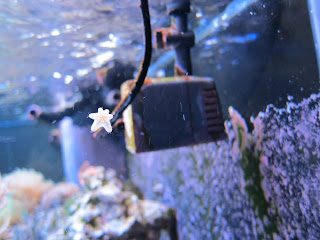
- Linksys Starfish (don't ever buy these either unless you have a very large, stable tank)
- Flowerpot Coral (don't ever buy these; they last 3 months, tops)
- Featherduster Worm (lasted about 1 week, fled it's tube and was never seen again)
- Ornate Leopard Wrasse (this broke my heart; he was gorgeous and peaceful but eventually starved to death. I later learned this is common with this type of fish. Not good for beginners due to their specialized eating habits. Most likely, my tank just didn't have enough copepods on the live rock to sustain the poor guy.)
That seems like a long list! Live and learn. On the other hand, there's a lot of good news too. Here are the successes:
- Pair of clownfish (now sexually mature). I got Bonnie and Clyde as captive-bred juveniles. They are all grown up and the OGs of the tank.
- Pair of male Banggai Cardinalfish. I was hoping Mr. and Mr. Roper would be a Mr. and Mrs. but it was not to be. However, the tank is large enough that both are happy. The dominant one definitely chases the weaker guy around but the smaller one has lots of hiding places (particularly the Elegance Coral). I actually tried to net the smaller guy out and give him to a friend for a better life but that was a disaster. So they are here to stay.
- Yellow Coris Wrasse (Louie). He has at least doubled in size!
- Scooter Blenny (Scooter). He has also grown and often displays his peacock sailfin. He's my favorite fish. I thought he wouldn't survive since he feeds on copepods and I got him only a month or two after my tank was set up. However, I think the refugium has sustained him very well. In addition, he now feeds on whatever I put in the tank.
- Royal Gramma (Phillipe). 3rd times a charm! I always wanted one for the tank. Hardy, peaceful and beautiful, my tank just wasn't complete without it. I lost the first 2 to bad luck but Phillipe is here to stay.
- Lawnmower Blenny (Earl). He helps with my algae problem but is also fascinating to watch. He likes to eat by smashing his head violently against the rock to decimate the algae, attacking his food.
- Bluejaw Trigger (Pedro). I know I shouldn't have a trigger in my reef tank but of all the triggers, he's the most peaceful. Although he's my prime suspect in the disappearance of some of the smaller denizens, he gets along really well with everyone else. Plus, he's just awesome! One of my favorites.
- Flameback Angel (Casey). Another one I shouldn't have in the reef tank. I've spotted him nipping the open brain coral a few times but other than that, he leaves the coral alone. He's a punk though, chasing everyone around (especially anyone new). Most everyone else just ignores his pugnacious attitude.
- Bluestreak Cleaner Wrasse (Nahla). She wasn't expected to survive in captivity. Often these guys are fussy eaters. However, she bucks the stereotypes. She's a voracious eater and quite spunky, often stealing shrimp right out of the Buejaw's mouth! She also loves cleaning everyone in the tank, including my arm when I'm doing housekeeping chores.
- Scopas Tang (Toby). A great algae eater with a unique shape, he's similar to the ever-popular Yellow Tang but much more peaceful and a better algae eater.
- Purple Firefish (Hazel). She's the newest addition to the tank. An easy keeper (eats meat), colorful and peaceful. She's getting hazed by everyone in the tank right now (hence the name) but seems to be settling in well, thanks to plenty of hiding places in the live rock.
- 3 Skunk Cleaner Shrimp. (The Merry Maids). They molt about once a month and lay eggs constantly (they are hermaphrodites). They also clean everyone in the tank (including me!). They've grown quite large, no longer a bite-sized snack to tempt Pedro. Definitely a favorite.
- Purple Collector Urchin (Spike). He was added to help clean the algae from the tank. He does a great job although I do feed him seaweed every now and then. He can wreak havoc at night (he's nocturnal), carrying any coral that's not adhered with epoxy away on his back. I learned this the hard way.
- Clam (Libby). I never knew they came in such brilliant colors! She decided she wanted to stick herself onto the bottom of a rock with her foot. I had to rearrange the rocks a little for better viewing. She's pretty awesome. Eats phytoplankton.
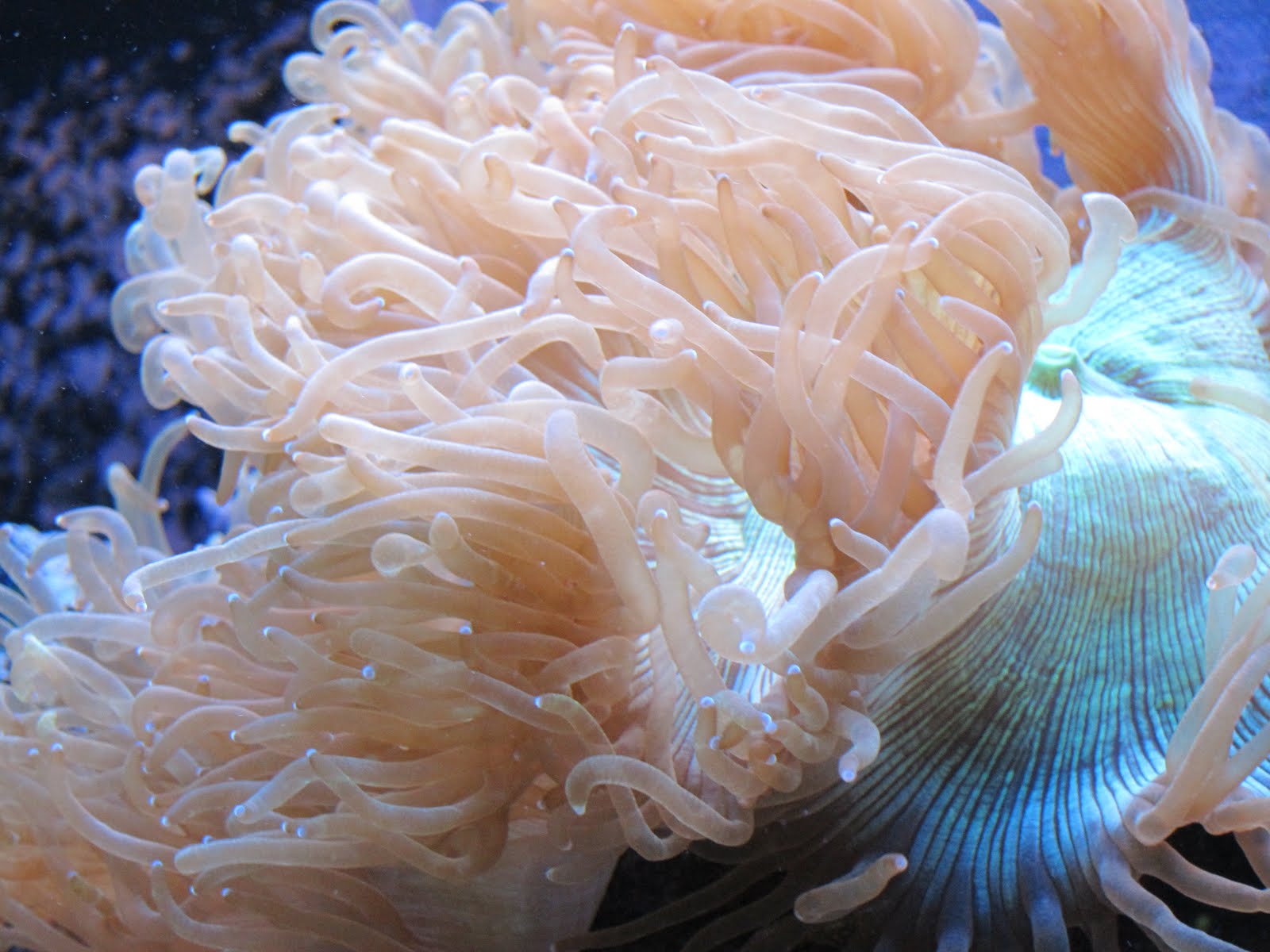
- Elegance Coral. This has thrived despite all warnings against success in an aquarium setting. The largest resident of the tank and the most eye-catching.
- Xenia Coral. No longer pulsing or growing as rapidly as it once did, however, it still claims a large territory on the rock.
- Frogspawn. Easy keeper. Loves to eat.
- Open Brain Coral. Not thriving as much as I'd hoped. It might do better with more frequent feedings.
- Leather Coral. Has at least doubled in size.
- Daisy Polyps. Easy keepers, fast growing, not aggressive. A real joy after the flowerpot debacle.
- Various mushrooms. Has grown exponentially. Are very colorful and wonderful.
- Various zoanthids. They have been growing rather slowly but finally are growing and finally thriving.
- Plate coral. The first SPS I've introduced into the tank. Hasn't really taken off yet. I think my tank is definitely more of a softie tank. Just not enough light (and no interest in adding more light, based on temp issues and very high electric bill).
- Clove polyps (Clavularia). Very hardy. Looks like a cross between xenia and daisy polyps. Very cool!
Friday, December 3, 2010
The Heater Works! (Phew)
Don't forget to make sure your heater is working!
Tuesday, November 16, 2010
R.I.P. Flowerpot Coral

Friday, November 12, 2010
Pictures! (As Promised)
Purple Pincushion Sea Urchin ("Spike"):
I absolutely love this guy. He's always crawling around and eating algae. He has thousands of little feet waving around between his spines. Very cool to watch!
Spike under the blue light. Note all the shells and rocks on his back (why he's sometimes called a "Collector" or "Pincushion" urchin).
Up the back wall to clean up algae! I never clean the back wall, allowing a little algae growth for my vegetarian critters. I also stuff a big kelp leaf in the rocks once in awhile. It breaks into little pieces and the fish go nuts.
Taking off with a clump of zoas (Lily). I quickly put the coral back. No coral was harmed in this photo. Spike sometimes gets a little "carried" away with his cleaning. Ha ha!
Toby, our Scopas Tang. I love the pale cream-brown, tiny stripes and white spots! Plus, his eyes can change color (from brown, shown here, to yellow). His fins are gorgeous too, like sails. Under the blue light, there's lots of blues and magentas that come out under the brown color. Who says this is a drab tang?
Tiny Tim darting in and out of rocks. He is sooooo cute!
Wednesday, November 10, 2010
Stay Tuned...
1. Spike, the Sea Urchin
2. Feather Duster Worm
3. Tiny Tim, our adoreable, miniscule Red-Headed Goby
4. Kobe, our new Scopas Tang
5. Montipora Plate Coral (our first SPS addition!)
Our tank is doing really well. We've had some minor things here and there, but overall, everything is awesome.
1. Algae update:
It took a few weeks to see the reduction in (hair) algae growth after reducing the light and feedings. We're now feeding only once a day and the light period has been reduced to 8 for the days and 10 for the blues. However, combined with weekly 20% water changes, addition of a sea urchin and some more snails, and vigorous scrubbing with a toothbrush, I'm happy to report that I'm winning the battle. I'm hoping to be able to cut back to 20% bi-monthly changes in the next few months. Mostly because, weekly water changes are A LOT of work!
2. Strangely Low Calcium and Alklanity Readings:
After our local go-to aquarium expert (Mike) said to start checking our calcium, I noticed it was low. It's always been on the low side anyway (calcium 420 ppm and alkalinity 8 dkH). I began adding the Bi-Ionic 2-part buffers to boost levels. Following the directions and adding conservatively (10 ml each for our 75 gallon tank), nothing happened. At the same time, our Elegance and Open Brain Corals began to look a little withered. I have been finding it necessary to add 40 ml each 3x a week to keep levels at 8 dkH and 440 ppm (calcium)! That's just absurd. Mike said I should be adding maybe 10 ml per week, if that. However, upon adding buffers, I noticed our coral perked up (the Elegance and Brain). I also saw an increase in coralline algae growth. The only thing we could think of is that we perhaps used distilled instead of RO water. We have been going to the grocery store and filling our buckets with the vending machine out front, instead of going to the LFS for RO. Maybe the Albertson's vending machine dispenses distilled? Back to the LFS for all our RO. No more second guessing.
3. Other Minor Happenings:
The Open Brain Coral appreciated being relocated to a lower flow area in the tank on the open substrate. It took some moving around in "mushroom city". Our low flow section of the tank is now densely populated; however, the Brain loves it. He blossomed, opened up, and expanded his tentacles almost immediately.
I replaced some of the old, nasty macroalgae in the refugium with fresh, new green stuff. Every week, I had been pulling some old out to allow room for new growth. This worked well for several months. Over the last several weeks, I noticed less growth of the macroalgae but unfortunately, rapid growth of the nasty, red microalgae. However, upon close inspection, I spotted a dense population of pods (they look like little bugs! Gross!). Not wanting to disturb them, I only removed a fraction of the old macroalgae before adding a ton of new. I think this was a good move. I now can safely say that it's good to replace the macroalgae with some new every 3 months or so.
I absolutely LOVE our automatic top-off dispenser. No more twice daily water top offs! Plus, it maintains a more stable salinity.
Our tank temperature dropped for the first time. Thank you cool fall weather! NOTE: Now that it's fall, don't forget to check to make sure your heaters are working! I was happy to see the little light indicator blink on our heater in the sump. Our temp is 78-79 for the first time (It was 80-81 over the summer). I can finally turn off the 3rd fan in the sump to save some energy (our other two are in the canopy by the lights and are temp regulated).
4. Tank Reports:
I'm happy to report that 2 out of 3 of our cleaner shrimp (the Merry Maids) are pregnant! Yes, they have millions of little eggs on their abdomens. Yay! That's a sure sign of a happy tank.
I've also spotted growth in our mushroom coral. I've been a little disappointed with the zoanthids. They're healthy but not growing as quickly as I expected.
The xenia is the one coral that's not doing so hot. Ever since moving around the rockwork (which caused the loss of our first Royal Gramma, Phillip) a few months ago, the xenia, which had been growing like a weed, suddenly stopped. However, it was still fully opened and pulsing. I could deal with that. Now, it's been wilting and pulsing very weakly. Maybe it has something to do with our odd water parameters (although xenia doesn't really care about alkalinity and calcium so much since it's a soft coral, there may be other trace elements it needs that the water is lacking which I haven't measured). I hope relying on the LFS RO water fixes this.
Stay tuned for pics!
Wednesday, October 6, 2010
Spike, our Purple Tuxedo Sea Urchin
A sea urchin!
These guys are the ultimate janitors of the saltwater tank. They are omnivores and eat any debris and algae left gumming up the tank. In the wake of the sea urchin's path is a blinding white streak of clean rock. It looks like someone took an army knife and scraped the rock clean! I LOVE it! Sea urchins are the "canaries" of the saltwater aquarium. At the first sign of less-than-perfect water quality, they begin shedding spines. If your sea urchin looks sickly, it's time for a water change. STAT! Some can quickly outgrow the tank and become predatory so do some research before selecting a species (from what I've read, pencil urchins are not reef-safe while the ones with long spines live on reefs in the wild and do well in aquarium settings as well). In addition, they love ALL algae, including coralline algae that we all work so hard to grow. Keep in mind, you may need to supplement your urchin's diet with seaweed to keep him from eating you out of house and home.
Spike is a Purple Pincushion Urchin, also called a "tuxedo" or "collector" urchin, since it gathers debris on the tops of its spines as it plows over the rocks, walls, and substrate, looking for food. He is really fun to watch. He crawls over everything with thousands of little feet! I absolutely love this guy.
http://saltaquarium.about.com/cs/aboutjanitors/a/aa052899_3.htm
http://www.peteducation.com/category.cfm?c=16+1910
http://www.enchantedlearning.com/subjects/invertebrates/echinoderm/Purpleseaurchin.shtml
http://tolweb.org/treehouses/?treehouse_id=4879
Tank Update
Problem: Algae Growth
Solution: Feed less and reduce lighting period.
How:
The fish are used to getting fed once a day. I don't want anyone turning into Mr. Hyde and gorging on cleaner shrimp so I'm reducing slowly. First, I'm feeding them less, period. Second, I feed them just a pinch of some dried food in the a.m. This makes it easier to cut this out. The next step is to begin "forgetting" a.m. feedings. I'll skip every other day the first week, then every two days, the second week, etc. until I'm no longer feeding in the morning.
To reduce the lighting, I will also do it slowly so as not to shock the fish and coral. In addition, I want to shift the lights to turn on later in the day so they can stay on later at night (when I get to see them). I'm tired of not being able to look at my tank. Evenings are the only chance I get! To do this, first I'll begin by having the lights switch on 1 hour later in the morning. Right now, the blue lights are on 12 hours a day, and the white lights are on for 10. I am going to aim for 10 for the blue and 8 for the white (and if that doesn't work, then 8 and 6). My goal is to have the blue lights come on at 1:00 pm and then turn off at 11:00 pm (the whites would be on from 2-10). I have to shift slowly. Maybe by 1 hour a week until I get it right.
Other tactics to reduce algae would be to add a few more snails. Worst comes to worst, I can always drop in a sea urchin!
Postscript:
Phil didn't last very long (the new Royal Gramma). He was very small and very shy. Basically, he was too scared to eat. The other tankmates would feed, and he hid in his cave. He wasted away until one morning, I discovered a cleaner shrimp eating his carcass. Nothing left but a skeleton. Sad.
A Peaceful State of Homeostasis
Here's a list of tankmates:
1. Bluejaw Trigger (male)--Pedro (very cute, peaceful, shy little guy, although we suspect he may have had something to do with the loss of one of our cleaner shrimp after molting).
2. Phil--new Royal Gramma (after the loss of Phillip when I removed all the live rock in a futile attempt to catch a Banggai). He's so small! He loves the caves and nooks and crannies in the rocks. I hope he grows up to be nice and big!
3. 2 Banggai cardinalfish (both males; ugh). The Ropers (Mr. & Mrs. even though they're both guys). One is dominant and still chases the submissive one around but the tank is large enough and has enough hiding places that Mr. Roper doesn't get picked on too badly. These guys hide a lot and don't like the bright reef lighting.
4. 2 mated Clownfish (Oscellaris). Bonnie & Clyde. We got these guys as babies (captive-bred). They are the friendliest in the tank, and always come out to say "hi". If you open the canopy, you can hand-feed them! They are finally maturing into sexual differentiation. The male does a "shimmy" dance to entice the female. Bonnie mostly just chases Clyde around but I've seen her fiercely defend Clyde from more aggressive tankmates. No saltwater tank is complete without a pair of clowns!
5. Yellow Coris Wrasse. Louie. This fantastic guy is very flashy. He is a late sleeper and often goes to bed early as well (or when scared), which is in a secret hiding spot in the sand. When out and about, he loves to show off and is quite active. He likes to bounce off the live rock! He also picks at the rock for food all day long. He particularly likes to steal tidbits from Scooter (scooter blenny) just to annoy him.
6. Scooter Blenny (aptly named, Scooter). He's my favorite! This guy is very personable and especially hams it off for the camera. He makes it a point to hop over to me and say hello every time I'm tank-gazing. He hops on the live rocks all day long, picking at it like a hummingbird. I was afraid he wouldn't do well in my new system but we added a refugium, and since then, he's doubled in size! In addition, his colors have darkened and reddened into gorgeous spots. I would love to get him a female one day.
7. Lawnmower Blenny, Earl. This fat, happy little guy spends all day chomping away at algae. He always has a mildly grumpy look on his face. When we tank-gaze, he'll pause to peer at us curiously before aggressively attacking his next patch of algae.
8. Bluestreak Cleaner Wrasse, Nahla. Although these guys often fare poorly in aquariums, we're keeping our fingers crossed. Nahla is fat and happy and verrrry friendly. She cleans all the fish in the tank, especially Pedro, Earl, and Scooter. She also eagerly attacks any meaty food I put into the tank. She has a nice fat belly on her. My favorite thing she does is to chase the rag when I wipe down the aquarium glass. She must think the rag is a big fish for her to clean!
9. Flameback Dwarf Angelfish, Casey. This guy is so brilliantly colored and renowned for algae eating. I took a chance on him, hoping he wouldn't pick at the coral. So far, so good. I keep him well-fed, and that seems to work well. He's definitely a pugnacious little fellow, however. He chases anyone away from his "territory" in the rocks but everyone else seems to just ignore him. With time, he's been settling down. Chill out, dude!
Coral and Other Inverts:
1. 3 Cleaner Shrimp, The Merry Maids (Mary, Melvin, and Melanie). I love these guys. They're pretty and are great at housecleaning. They even clean the fish! Plus, they lay eggs from time-to-time, feeding the fish! Actually, Melanie, our new addition, came in with thousands of little, tiny eggs attached to her legs. Way cool!
2. Various zooanthid frags (4 pieces)
3. Various mushrooms (all sorts of cool colors!). 4 pieces
4. Leather coral
5. Toadstool coral
6. Xenia (growing like a weed)
7. Elegance coral (so far doing great)
8. Frogspawn
9. Open Brain Coral (so cool)
10. Flowerpot Coral (so far, doing great)
We also have a number of snails and hermit crabs, the clean-up crew!
I measure tank stats monthly (although I check the temp, pH, salinity, calcium, and alkalinity weekly). Our water chemistry has been verrrry stable. Yea!
Temp: 81
pH: 8.5
Salinity: 1.024
Alkalinity: 8 dkH
Calcium: 400 ppm
Ammonia, Nitrites and Nitrates: 0 ppm
Phosphates: 0 ppm
Tank Maintenance:
Daily--Fish get fed 2x/day (a variety of meat, kelp, spirulina, and freeze-dried Copepods (Clyo-eeze), in the form of frozen, pellet, and flake food).
Empty skimmer cup.
Wipe algae off glass with magnet.
Check water levels in automatic top-off container.
Check to make sure light timers are working correctly.
Observe overall fish and coral behavior and health.
Bi-weekly--LPS corals and button polyps are fed with a turkey baster (meaty foods like mysis shrimp, crab meat, and oyster and prawn eggs). The elegance coral, brain coral, frogspawn and button polyps go nuts for it. Weird and wacky stuff to watch coral feed. I have to feed the fish right before so they don't steal the coral's food.
Weekly--20% water change (20 gallons). I'm trying to keep up on the algae growth in the tank so my water changes have been fairly aggressive as of late. Simultaneously, I thoroughly scrub the algae off the glass, substrate, rocks, and powerheads. I also change the filter sock and test any water parameters needed. Calcium and alkalinity buffers are added as needed.
Monthly--In addition to my weekly water change, I swap out the activated carbon in my media reactor. My cleaning is a little more vigorous, focusing on pumps, motors and other equipment. Thorough test of water chemistry is also done.
So far, this has worked well for me. I choose to feed my tank pretty heavily. It works so far because of superb filtration equipment and aggressive water changes. Another option would be to feed less, and change water less. But I like seeing fat, happy fish!
Seahorses at Birch Aquarium

The Medicine Cabinet
Here's a brief overview of what to stock in your fish medicine cabinet and how to use it, should your fish become sick:Cupramine (copper medicine)
What it Treats:
Ectoparasites like Marine Ich (Cryptocaryon irritans), Marine Velvet (Amyloodinium ocellatum), and Gill Flukes.
How To Use It:
Use 1 ml (stock is 10,000 mg/l) per 10.5 gallons for final concentration of 0.5 mg/l
Add once and leave for 14 days
Use a test kit (from same manufacturer) to measure copper levels
Therapeutic at 0.2 mg/l and toxic at 0.8 mg/l
Advantages:
Cupramine is safer than other copper medications (copper sulfate, chloride, citrate). It's less toxic to fish and also does not precipitate out of solution. There's no risk of fluctuating copper levels. In addition, it's more effective than chelated copper meds.
Notes:
Removable with carbon (this is why you always remove your carbon filter before adding meds; to remove meds at end of treatment, just put the filter back)
Do not add more unless test copper concentration with test kit (from same manufacturer)
Do not use with any other medications (reducing agents, like formalin, increase copper concentrations to toxic levels)
Links:
http://www.seachem.com/Products/product_pages/Cupramine.html
Formalin (37% formaldehyde)
What it Treats:
Parasitic infections, particularly hard-to-treat Brooklynella (Clownfish Disease)
How To Use It:
Use as a bath
1 ml of 37% solution per gallon water
Make sure temp below 80, pH 8.0-8.4, and vigorous aeration with airpump included.
Treat 45 minutes 1x/day for 3-5 days
Notes:
Formalin is pretty toxic (it's a carcinogen; wear gloves). In addition, it sucks oxygen out of the water. Temperature and pH affect formalin toxicity (above 80 degrees, it takes out even more oxygen). Be sure to use vigorous aeration. Methylene blue is often used in conjunction (it helps the fish get more oxygen).
Links:
http://www.reefland.com/forum/marine-fish-care-health-disease-treatment/25290-formalin-treatment-marine-fishes.html
http://saltaquarium.about.com/od/ichparasiticdiseases/ht/treatbrooklynel.htm
Methylene Blue
What it Treats:
Fungus and some external protozoans like ich
How To Use It:
add 1 tsp of 2.3% solution per every 10 gallons (3 ppm final concentration) in QT for 3-5 days; only one application is needed
use water change plus carbon filter to eliminate methylene blue at end of treatment
Notes:
Methylene Blue is an oxygen transporter for fish, increasing ease of respiration (great in conjunction with formalin since formalin compromises oxygen)
Can be used in conjunction with some medications (check manufacturer's instructions carefully)
Not effective bacterial infections, flukes, or brookynella
Removed by AmQuel at high concentrations
Links:
http://www.novalek.com/kordon/methylene_blue/index.htm
Malachite Green
What it Treats:
Treats ich, fungus, and other external parasites (gill flukes)
How To Use It:
use 1 tsp per 10 gallons
as a bath: 1-2 mg/l for 10 min or 0.5 mg/l for 1 hr
Notes:
Often used in conjunction with formalin
This is toxic stuff! Use caution.
De-Wormer (Praziquantel)
What it Treats:
Tapeworms, roundworms and other internal parasites
How To Use It:
Can use as a bath (1 tsp per gallon) in QT for 5-7 days
Often mixed with food
Links:
http://www.reefsanctuary.com/forums/fish-diseases-treatments/37765-de-worming-marine-fish-super-pooper-snooper.html
Antibiotics
What it Treats:
Bacterial infections (pop-eye, bladder infection, fin rot, etc.)
How To Use It:
Add to QT water per manufacturer's instructions and/or food
Notes:
Start with broad spectrum antibiotics, ones that kill both gram-negative and positive bacteria.
These include:
Neomycin
Chloramphenicol
Nitrofurazone based products
Skin absorbed kanamycin sulfate based antibiotics (Kanacyn/K-Mycin)
Try a product like Spectrogram (Aquatronics) or Maracyn One, followed by Marcyn Two.
Other Antibiotics:
Tetracycline
Sulfathiazole
Metronizazole (treats protozoan and anaerobic bacterial infections in fish as well as dinoflagellate infections)
Note: Many of these chemicals are toxic to humans. Please wear gloves and handle carefully.
Links:
http://www.reefland.com/forum/marine-fish-care-health-disease-treatment/18893-stocking-marine-fish-medicine-cabinet.html
https://www.fosterandsmithaquatics.com/pic/article.cfm?N=2004&aid=1338
Primer on Common Marine Fish Illnesses

We've gone over how to do a freshwater dip and how to set up a hospital tank. But what about the meat and potatoes? What does a sick fish look like? What diseases do fish get, and how do we get rid of them?
A sick fish displays obvious changes in normal behavior. Erratic swimming patterns, listless behavior, lying on its side, dull or pale color, loss of appetite, rapid breathing, and white, fluffy patches on skin, gills, or body, all of these are signs of a sick fish. The earlier you spot the symptoms, the better a chance you have of successfully treating and healing your fish!
Why do fish get sick?
Stress. Simple as that. Stress weakens the immune system making the fish more susceptible to disease. Stress comes in many forms including:
1. Shipping and transport.
2. Introduction to a new tank.
3. Poor water quality or sudden changes in water parameters (salinity, pH, temperature, calcium, alkalinity, ammonia, nitrites, nitrates).
4. Poor nutrition (not feeding enough or the right kind of food).
5. Boistorous, aggressive tankmates.
6. Poor enivronment, e.g. tank too small to meet space requirements of fish.
Common Fish Illnesses:
1. Cryptocaryon irritans (Ich)

This is an obligate parasite (meaning it cannot survive without its host) with a complex life cycle often introduced from new fish, coral, or live rock. ) (It's actually a ciliated protozoan). Tangs and surgeonfish are particularly susceptible. Death can result in a few days.
Ich Links:
http://www.chucksaddiction.com/ich.html
http://www.advancedaquarist.com/issues/nov2003/mini1.htm
http://reefkeeping.com/issues/2003-08/sp/index.php
http://saltaquarium.about.com/od/ichparasiticdiseases/a/aa_cryptocaryon.htm
2. Marine Velvet (Amyloodinium ocellatum).
Symptoms are similar to ich but instead of punctate white spots, the fish has more of a white powder covering its body, almost like its been dipped in powdered sugar. Caused by a parasitic algae (actually a dinoflagellate). Symptoms start off with labored breathing. Powdered spots occur later. Because it attacks the gills first, marine velvet is more serious than ich. By the time you see it, it may be too late. In addition to powdered spots and labored breathing, swimming may also be erratic. Fish may also rub against rocks and gravel. Death can occur within two days of symptoms. Hyposalinity is not effective for this parasite. Cholorquine diphosphate (also used to treat malaria!) is a good treatment (5-10 mg/l for 10 days). Metronizazole will also treat dinoflagellate infections. Copper, formalin, and freshwater dips are also common treatments. As always, these chemicals are toxic invertebrates, micro-/macro-algae, and nitrifying bacteria.
http://www.aboutfishonline.com/articles/marinevelvet.html
3. Black Ich (Turbellarian)

Also called Tang or Surgeonfish disease because it is often seen on Yellow Tangs. Like ich but black spots instead of white. This disease is actually caused by turbellarian flatworms from Paravortex genus. This disease is not as quick-killing as Ich or Marine Velvet but needs to be treated to prevent secondary bacterial infections from occuring. Treat with freshwater dip followed by formalin bath and recovery in QT tank.
4. Brooklynella (Clownfish Disease)
Worst of the parasites. Often seen in wild-caught clownfish. This is a cilliated protozoan that can reproduce asexually, spreading much faster than Ich or Marine Velvet. Attacks gills first, which makes breathing difficult. First symptoms include rapid/labored breathing, thick, excess mucous secretion, color dulling. Lethargy, loss of appetite, cloudy eyes also occurs. Toxins secreted from protozoa cause open ulcers gills and skin. Death can occur in 12 hours if not treated immediately. Remove to QT tank and perform daily baths in formalin. Other treatments, like hyposalinity, freshwater dips, or copper, are not effective.
Brookynella Links:
http://saltaquarium.about.com/cs/compldiagnodisease/a/aa041701.htm
http://www.chucksaddiction.com/brookynella.html
http://www.wetwebmedia.com/ca/volume_6/volume_6_1/brooklynella.htmme_6_1/brooklynella.htm http://www.fishvet.com/Brooklynella.htm
http://www.aquaworldaquarium.com/Articles/TonyGriffitts/treating_marine_fish_for_bacterial_Diseases.htm http://saltaquarium.about.com/cs/compldiagnodisease/a/aa042801.htm
1. Fin Rot
http://saltaquarium.about.com/cs/compldiagnodisease/a/aa053001.htm
http://www.helium.com/items/1655919-aquarium-fish-vibriosis-causes-and-treatment
http://theaquariumwiki.com/Vibriosis
4. Fish Tuberculosis
http://www.aquarticles.com/articles/management/Keefer_FishTB.html
http://www.petfish.net/kb/entry/170/
http://www.aquaticcommunity.com/disease/tbc.php
http://reefaquariumtrials.blogspot.com/2010/09/help-sick-fish-lymphocystis.html
Flukes and Parasitic Copepods:
http://www.aquaticcommunity.com/disease/flukes.php
http://www.algone.com/aquarium-articles/fish-health/aquarium-worms
http://saltaquarium.about.com/cs/headlledisease/a/aa040901.htm
http://www.chucksaddiction.com/disease.html
http://www.aquaticcommunity.com/disease/sw/
http://www.aqua-fish.net/saltwater/?marine-fish-disease
http://saltaquarium.about.com/cs/compldiagnodisease/a/diseasetrouble.htm
http://www.saltwater-aquarium-online-guide.com/fish-diseases-and-treatments.htmlases-and-treatments.html
http://www.tropicalfishexpert.co.uk/SaltwaterFishDisease.html
http://www.fishlore.com/Disease_Saltwater.htm
http://www.advancedaquarist.com/2007/6/fish
http://www.wetwebmedia.com/infectio.htm