Thursday, September 9, 2010

Scarlet Skunk Cleaner Shrimp


Shrimp! Shrimp! We added shrimp!


These invertebrates add a lot of diversity to the aquarium and do a lot of beneficial housekeeping. They are very active, have lots of personality and are fun to watch. I LOVE the red and white stripes down the back! Peaceful and reef-safe, they made ideal additions to our aquarium. These guys are omnivores and clean detritus off the live rock and substrate. Amazingly, they will approach large fish and even moray eels to clean parasites off of them! If you stick your hand in the tank and let them get used to you, they will crawl onto your hand and pick off dead skin! These guys are the Merry Maids of the tank.


Like other invertebrates, they are intolerant of high nitrates, copper medications and fluctuatations in the environment (like temperature). Be sure your tank is stable and at least 3 months old before adding them. Sadly, we lost one of our shrimp within 5 days after adding it, most likely due to fluctuations in the water temps (although we'll never know). I'm keeping my fingers crossed on the other two; they seem to be really active and healthy.


The scarlet skunk cleaner shrimp like to be housed in groups; they're pretty social little guys. Interestingly, these guys are hermaphrodites. Pick two, any two, and they will breed, providing your tank with supplemental, nutritious food (sorry, you won't have any shrimp left over to hatch out unless you protect them in a refugium--the babies end up as fish food).


Do not keep adult shrimp with other predatory fish like lionfish or hawkfish or they will end up as expensive food. Make sure you use the drip method to acclimate your new shrimp to your tank as they're pretty sensitive little critters (take about 45 minutes at 1-2 drips/second before adding them to the tank).


Also, a healthy shrimp molts about 1x/month as it grows. This requires low levels of iodine in the tank (usually present in either the salt mix or reef supplements added to a reef tank). Ours molted immediately, one within a day and the other two, within a week. Of course, I didn't know anything about molting and freaked out when I found a complete shrimp exoskeleton in the tank the next day. I was totally upset, thinking the shrimp had died. I told Greg, sadly, about the passing of our poor shrimp. Befuddled, he scratched his head and wondered why he still counted three (unfortunately, one did die a few days later). All of our shrimp have now molted, although I still freak out and have to do a head count every time this happens.
Exoskelton left over from molting shrimp.

P.S. I was recently asked how long they live. I looked it up. Lifespan is about 3 years. Not bad!

Links:
http://www.freeinfosociety.com/site.php?postnum=268
http://www.aboutfishonline.com/articles/cleaner-shrimp.html
http://www.fishlore.com/profile-skunkcleanershrimp.htm

Tuesday, September 7, 2010

When Good Fish Go Bad--Kujo, our Midas Blenny

So we recently added a Midas Blenny to the tank. I read over and over that these fish are "ideal additions to a reef tank". They eat a mix of meaty foods and algae (unlike other blennies that eat mostly algae). He is supposed to be shy and peaceful, hiding in cracks and crevices in the live rock. He's long and swims in an eel-like fashion. In addition, the Midas Blenny is beautifully colored, a golden yellow with blue eyes and pink/orange stripes. He also changes colors depending on his mood! Originating from the Indo Pacific, they are hardy and reef-safe. (You need a canopy on your tank because they are expert JUMPERS!) Obviously, I was sold.
I was more than surprised when ours turned out to be a freak of nature. The first giveaway should have been his size. He's HUGE. I normally like to buy babies and let them grow up in the tank, adapting to the captive environment. But I thought this guy was cool (big warning sign--never buy a fish because you think he's "cool"). Instead of the average 4 inches, this Midas Blenny was at least 6".

I took him home and plopped him into our tank, where he hid for 2 days. I noticed his beautifully changing colors, pale and splotchy when scared and brilliantly orange-streaked when feeding. Then, he started turning into a terror. King Midas (or Kujo, whichever you like better) began emerging from his cave in the live rock more and more, swimming awkwardly across the entire tank.

He "claimed" the entire 75 gallons for himself. First, he picked on little Bonnie and Clyde, our peaceful little clownfish, banishing them to the powerhead region. Then, he chased Louie, our canary wrasse into the sand. He chased Phillip, our royal gramma, out of his cave, deciding to claim it for himself (only to return to his original cave, front and center, later). Much to my dismay, the carcasses of two of our newly added cleaner shrimp appeared the next two following morning. Our Banggai cardinalfish have gone into hiding. He even chased Pedro, the bluejaw triggerfish, away from some choice mysis, although Pedro didn't take his bluff. Finally, upon spotting an intruding hermit crab, cleaning near the mouth of his cave, King Midas flew into a tirade, grabbed the poor, innocent crab by the shell, who was just doing trash pick-up, and threw him into the sand. Subsequently, King Midas has done this on multiple ocassions to several, unsuspecting hermit crabs passing by. Every time Scooter, my precious little scooter blenny, hops by on the live rock, I hold my breath and break out into a cold sweat, especially since King Midas is about 6x bigger!

Upon digging a little deeper, I discovered that Midas Blennies are extremely territorial. Normally, you would get a little one, he would claim a small cave, defend that little area, and that would be it. This guy is just too big for our 75-gallon tank. He seems pissed off and all the other members of the kingdom are now living in terror, tiptoing around their suddenly shriveled domains. I do think we got a freak when it comes to Midas Blennies. Everything I've read about them says they're peaceful, full of personality, and loveable fish. Unfortunately, ours is just an asshole. Needless to say, I'm returning him today. Sigh. Live and learn. The first (okay, tenth) of many mistakes to come.


P.S. Returning a fish is NOT easy to do. Think about what you're adding to the tank VERRRRRY carefully! Because if it doesn't work out....you're going to have to C.A.T.C.H. it again. Easier said than done. We basically scooted King Midas into a cave in the live rock, hauled out the live rock (dismantling the entire aquarium), plopped it into a bucket with tank water, put a lid on it, and drove to the store where the staff then dealt with getting Midas out of the rock. Phew! I'm exhausted. But our tank kingdom is peaceful and calm again.

Links on Midas Blennies:
http://www.aquaticcommunity.com/blennies/MidasBlenny.php
http://ezinearticles.com/?Tips-on-Midas-Blenny-Care&id=3297853
http://www.aboutfishonline.com/articles/midas-blenny.html

Tuesday, August 31, 2010

Sea Cucumber Hitchiker!

Oh...My....God....Look at what I found in our refugium! It's a hitchiker. I didn't know what the hell it was. Mike, our aquarium expert, identified it as a sea cucumber. This is the coolest thing ever!

In case you didn't believe me, here's a close up of this creature. What should we name him? Her?
About Sea Cucumbers:
Some can grow up to enormous lengths. Also, many reef aquariusts fear them because when they die, they release a lethal dose of toxins that can "nuke" the entire tank. This guy is small enough that Mike told me not to worry. Plus, he seems happy in the refugium. He's in a safe place where no one picks on him as well. We've decided to risk the "nuclear" potential of this guy and keep him because he is just so dang cool! I looked him up: he's a "Yellow Knobby Sea Cucumber", originating from the Indian ocean, often sold for $20 each. Cool! (The official name is: Colochirus robustus). He's a supsension feeder that needs lots of detritus and phytoplankton, as well as rotifers. No wonder he likes my refugium!
Cool Facts about Sea Cucumbers:
  • They can spill out their guts as a defense mechanism. Evisceration. They then grow their guts back. Ewww!
  • Sea cucumbers communicate with each other by sending chemical signals through the water.
  • They can reorganize their endoskleton in order to fit through small cracks (they liquefy themselves, squeeze through, and become solid again). I wish I had that superpower!
  • They are scavengers and eat detritus found on the sea floor. You can also feed them phytoplankton.
  • Sea cucumber are slow, fairly sedentary creatures.
  • They breathe, eat, and poop out of the same orifice. Ewww!
  • They can go for long periods of time without eating and actually can partially eat themselves for sustenance! Ewww! (If your sea cucumber is getting smaller, it needs to be fed! Stat!)
  • The "toxins" secreted as a defense mechanism by some sea cucumbers are being studied for its anti-inflammatory and anti-cancer properties. Cool!
  • They can reproduce asexually---by splitting into 2! Neat!
Sea Cucumber Links:


Random Pics of my other Non-Aquatic Pets:

Floyd and I cuddling on the sofa.

Floyd gets rambunctious and wants to play.

Travis hears the commotion and gets jealous, leaping on top of us.
"That's MY person!" Travis protests.

Friday, August 27, 2010

Leather Finger Coral


Leather Finger Coral

We got this guy last week with the Banggais (Mr. Roper is now hiding in the rock and Mrs. Roper chases him back into hiding whenever he emerges. We believe he may be hatching eggs in his mouth!). Anyway, this is our Leather Finger Coral. It comes in lots of different colors. I've seen many pink and tan ones but this one is fluorescent green! It likes a spot with high water flow (although after putting it in a high water flow spot, it seemed to retract; we may move it to a medium flow spot instead). Like other softies, this guy needs less light than his stony cousins. Because of it's soft body, it's only means of defense is chemical warfare. It secretes toxins to impede the growth of competing corals around it. The main reason we selected this guy is that they are H-A-R-D-Y! Plus, they grow big and tall with cool-looking branches like a tree, which is different from our other corals.

This guy is in the Alcyoniidae family (and in the Lobophytum genus). Confusingly enough, the list of common names for the leather finger coral goes on and on: Thin Finger Leather Coral, Knobby Finger Leather Coral, Devil’s Hand/Finger Leather Coral, Dead Man’s Finger Coral, Bushy Soft Coral, Chili Pepper Coral, Cabbage Leather Coral, Trough Coral, Sinularia Finger Thick and Lobed Leather Coral. Geez! Pick one and stick with it!

Links:
http://www.livestockusa.org/LEATHERS.html
http://www.thesea.org/leather_coral/finger_leather_coral.htm
http://www.themarinecenter.com/corals/coralssoft/leathercoralfingerleather/alssoft/leathercoralfingerleather/ http://www.associatedcontent.com/article/385392/finger_leather_coral_branches_in_your.html?cat=53

Thursday, August 19, 2010

Banggai Cardinalfish--Latest Addition!

We recently acquired a new pair of fish for our aquarium. I had been craving for a pair of Banggai Cardinalfish from day 1. However, every LFS (local fish store) seemed to only have Pajama Cardinalfish (see pic at bottom). I was a stickler for the Banggai guys; I just couldn't resist the black and white spots! I knew these guys would be perfect for my peaceful reef tank. They are shy, reef-safe, and extremely hardy.

Unfortunately, these guys are now on the endangered list due to overfishing to support the aquarium trade. I have been careful to support an eco-friendly tank. That would have been enough to nix the idea; however, turns out that these guys are a snap to breed in captivity. I became very excited when I spotted several juveniles at my favorite LFS. My heart sank when the fish guy told me they were wild-caught. I refused to purchase them. Upon visiting my 2nd favorite LFS, I spotted several mature Banggai Cardinalfish. These guys were captive-bred! Plus, they were very healthy. I selected a male/female pair that seemed very happy together.

Upon acclimating them to my tank, they proceeded to hide among the live rock, despite the fact that they are the biggest fish in the tank. Guess they just see themselves as bigger targets. They are verrrrry cool. Definitely shy, they don't stray far from their favorite hiding places. They don't swim around too much; in fact, they often supsend motionless in the water, despite the strong current. It probably would take less energy to just swim rather than fight the current to stay immobile! They get along with everyone else in the tank just fine. The male is obsessed with his reflection in the glass and spent 3 days challenging his mirror image to a duel. I pushed him away from that spot several times with my hand. Now he's set up post on the other side where he discovered yet another mirror image challenger. Ugh. We named them Mr. and Mrs. Roper due to their grumpy appearance. They appear to always be pouting due to their giant mouths.

Other facts about these guys?
They come from the Banggai islands in Indonesia. Their official name is Pterapogon kauderni, and are carnivores. You might want to take notes; there will be a quiz later. They are extremely easy to breed in captivity, partially due to the fact that they are mouth brooders, meaning that they hatch the eggs in their mouths (this is why their mouths are so big!). In fact, once the female releases eggs, the male actually is the one to care for the eggs in his mouth. For 20 days, the male carries the eggs, meaning that he doesn't eat during this time. Wow! Talk about chivalry. If only it were this way for our species. ;)

We're hoping our guys breed. Not only would it be fun, but I could give them to my favorite LFS to convince them to stop supporting the endangered wild-caught Banggai Cardinalfish. Right now, the narcissitic Mr. Roper is too obsessed with his reflection to court poor, lonely Mrs. Roper. Talk about vanity! Mirror, mirror on the wall, who is the fairest of them all? If he were human, he would be strutting around on the beach in his Speedos, waxed, oiled, and tan, flexing his muscles for all the sunbathers.

How can I tell the female apart from the male? This took some careful research and observation. The male has a longer 2nd dorsal fin from the female. Unfortunately, it often gets trimmed down due to pesky nipping by tankmates and is not a reliable marker. The males also have a squarer jaw, probably to accomdate carrying the babies. This was much easier for me to spot. Of course, the easiest way to sex a Banggai Cardinalfish is to put the unknown gendered fish (we'll call it "Pat") into a tank with a previously identified male. If Pat is a male, the two will fight (please quickly remove him to prevent a fatality). If Pat is female, the male will court her. Wish us luck on our breeding project!

Mrs. Roper peacefully swimming with Phillip and one of the clownfish (we don't know which one is Bonnie or Clyde yet). She never strays far from her hiding place. Here, she is wishing Mr. Roper would stop staring at himself in the mirror and keep her company.

Mr. Roper, annoyed that I pushed him away from his reflection. He returned to talking smack to his mirror image seconds after this shot was taken. Note that Mr. Roper's jaw is squarer and more pronounced than Mrs. Roper's (above).

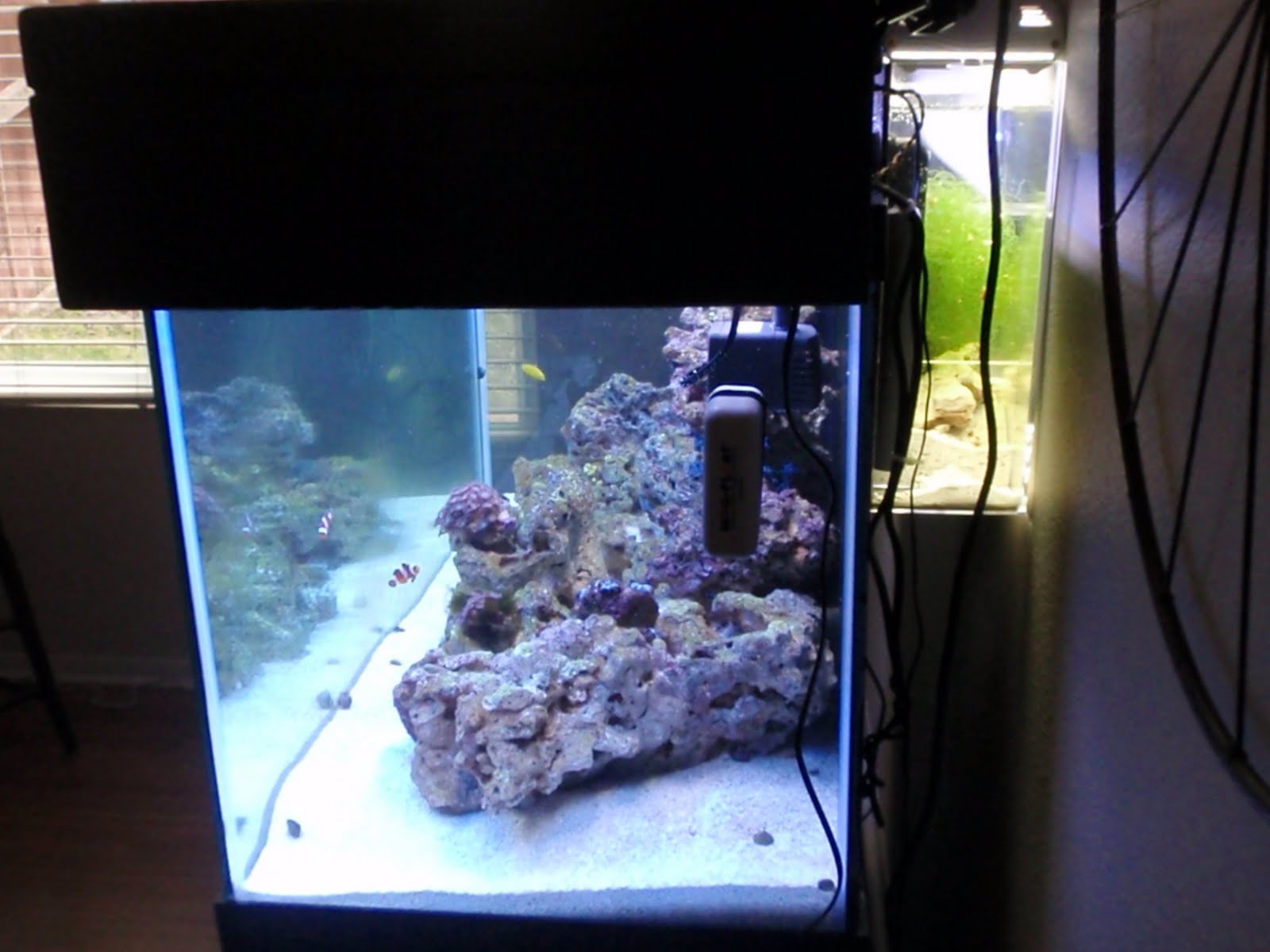
Taking a step back, this is our tank, almost 3 months in the making. Not bad, eh?


Not our fish, this is a good example of male/female differences. The male (top) has a longer 2nd dorsal fin and more prounounced, squarer jaw than the female (below).

A picture of a Pajama Cardinalfish, closely related to the Banggai Cardinalfish. Pretty but not as much as ours! Maybe I'm biased.
Links for Banggai cardinalfish:

Wednesday, August 11, 2010

Soft Coral for Beginners

These soft corals are hardier, require less light and won't suffer as much as their more finicky cousins, the hard, stony corals. Instead of producing a calcium carbonate skeleton, like their stony cousins, they have tiny skeletal elements, or sclerites. These guys still need light to thrive but less. Like all coral, they form a symbiotic relationship with zooxanthella for most of their energy requirements but these coral will also eat brine shrimp and other free floating food that happens their way. (I've witnessed my zooanthids closing up to catch mysis after a feeding; not only my fish are eating!) Coral still needs great water quality, good lighting (day and blue T5s, for instance), and higher calcium and alkalinity levels than you would normally need for a fish-only system. But these requirements are very easy to meet, and the advantages of having gorgeous coral in your tank far outweighs the small increase in caring for them. Also, keep in mind, each coral prefers a certain type of water flow (strong, mild, or low). Water movement is important.

Mushroom Coral:
Aka Corallimorphs, mushroom anemones
Aptly named for their mushroom-like appearance, these guys come in a variety of colors and are among the hardiest of the soft corals. Unlike most other corals, they actually prefer lower levels of light and low current. Put these guys towards the bottom of the tank. I just moved my purple mushroom ("Sloth") from a high current to a low-flow area, and he instantly perked up.

Purple mushroom (2 on bottom sides of rock)
(aka "Sloth")
Note the Zoanthid Coral on the top (Protopalythoa sp.) or "Pippi Longstalkings"

Blue-striped mushrooms (The Peppermint Patties!)

Green-striped mushroom (Actinodiscus) or "Disc Anemones"
I've also seen "Bluestriped Mushrooms".
So pretty we call her "Vegas"!

Zoanthids:
Aka Zoanthidea, Sea Mats, Colonial Anemones, Button Polyps
Another great beginner soft coral for the aquariums, these guys also come in a variety of shapes and colors and are very hardy. They prefer strong water movement and lots of light. They have small, disc shaped polyps that resemble clusters of flowers. Actually, they are called hexacorals by biologists since their tentacles come in pairs of 6 (so do mushrooms). They also grow rapidly (I can personally attest to this! Both Pippi and Lilly have sprouted babies since we acquired them only 1 month ago). These guys are closely related to Cnidaria (anemones). They come in lots of brilliant colors (reds, greens, blues, etc.) and are constantly moving, making them fascinating to watch.

We named this pretty Zoanthid "Lily". Don't forget to take a look at "Pippi" (above in mushroom section). Zoanthids can come in all different sizes, shapes, and colors!


Xenia Coral:
Aka Xenia elongata, Pulsating Xenia
One of the "pulse corals", this hardy soft coral is known to grow like a weed. Shaped like tiny, daisy-like flowers, I thought the name "Xenia" was very appropriate. It reminded me of Zinnias I used to plant in the garden. Watching the polyps sway in the water is mesmerizing (pulsing). This coral is sustained 100% by photosynthesis and is rumored to do better in slightly "dirty" water with more nitrate and phosphate (one that is less heavily skimmed--no chance in my tank, unfortunately). Like other true soft corals, xenia has eight polyps (octocoral). Occasionally, xenia will "crash" and die out, causing a release of a huge amount of toxins into the water as the coral decays. Xenia likes high water flow and intense light.

Xenia reminds me of a flower so I named her "Flower". Obvious, I know.

Toadstool Coral:
Aka Sarcophyton trocheliophorum, Toadstool Leather Coral, Leather Coral, Trough Coral
This gal was so unusual and pretty, I was stoked to learn she would do well in our tank. The tightly clustered polyps are bright green atop a pink base. The polyps sway in the water, giving it the appearance of a small anemone. He likes low water flow and lots of light. In addition to photosynthesis, the toadstool coral benefits from supplemental feeding of some occasional brine shrimp and phytoplankton. These guys can grow quite big. I can't wait!

I named her "Tuffet" like "Miss Muffet sat on a"... you get the idea.
Frogspawn:
Aka Euphyllia divisia, Wall, Octopus, Grape Coral
Technically, Frogspawn is an LPS (large polyp stony) coral, not a soft coral. This guy requires a bit more attention than the others but I just loved him. The tentacles area a pale, fluorescent green and are constantly swaying in the water. Also, clownfish sometimes adopt Frogspawn in lieu of their host anemone. I'm keeping my fingers crossed! They prefer moderate to low water movement and strong light. Frogspawn thrives on a combination of meaty foods, like mysis and brine shrimp, as well as photosynthesis. This guy is semi-aggressive (he stings competing coral) and can encroach on other corals if not watched; he needs plenty of room.
http://www.aquahobby.com/corals/e_euphyllia_divisia.php
http://www.fishlore.com/coral/frogspawn-coral.htm

--on the left (One-Eyed Willy, a zoanthid is on the lower right), I named him Kermit! Scooter is checking him out on the rock to the right.

There are many other corals we are interested in (Leather Coral, Gorgonian, etc.) but this is a good start!

Links:

Royal Gramma!

I visited my LFS (Pet Kingdom) the other day to pick up some RO water, aragonite substrate and activated carbon. Ugh. How boring. It was like going to the grocery store. I treated myself to a slow, walk-through by the aquariums, "just looking".

I spotted this little guy and was instantly SOLD! The Royal Gramma has been on my list of fish to put in my aquarium. This fish is small, hardy, peaceful, reef-safe, and beginner friendly. Not to mention...G.O.R.G.E.O.U.S.!

We took him home and put him in the tank. He immediately hid in the live rock for 2 days. I knew he would be shy but c'mon! We named him "Phillip". We thought it sounded "Royal" (kind of like our Louie--the Canary Wrasse). Plus, it's kind of wimpy. And Phillip is verrry wimpy! Even Scooter, our mild-mannered little Scooter blenny can bully him around (much to his chagrin).

Phillip is finally coming out to eat and explore on Day 3. I love this guy!

Phillip--emerging from the live rock but still not straying far from his hole.

Is Phillip hamming-it-up for the camera?
Yes, Phillip is definitely showing off.
Other Facts about Royal Grammas:
These guys are very strikingly colored with their heads being a dark purple and tails a bright yellow. They hail from the Caribbean region of the Atlantic and are also known as the "Fairy Basslet". Although peaceful and shy, they are territorial when it comes to defending their cave in the live rock. Phillip will dart out and try to chase Scooter and Louie away when they pick at the rock near his hole. These guys are also carnivores so they get the mysis mix I feed the tank in the a.m.
Note:
Royal Grammas are similar to looking to the Bicolor Dottyback. However, it's easy to tell the two apart. Dottybacks have a solid line that separates the purple from the yellow, whereas the Gramma bifurcation between the two colors is blended. In addition, the purple on the Gramma tends to be darker (the dottyback is more of a pink/pastel color). The dottyback is a bit smaller as well and lacks the flashy eyespot on the dorsal fin that the gramma has. Although the Dottybacks are another popular choice for beginner reef aquarists, they are considerably more aggressive despite their small size. For this reason, I selected the Royal Gramma since I'm going for a more peaceful community reef tank.

Bicolor Dottyback (NOT a Royal Gramma)

Tuesday, August 10, 2010

A Brief Primer on Algae: the Good & the Bad

Algae: Friend or Foe?

I thought all algae was bad in aquarium-speak. But I spoke too soon. Normally, we try to get rid of algae in our aquarium. Algae is not necessarily bad, in and of itself; however, it is a sign that you have an underlying problem. In other words, algae is the symptom, not the disease. Things like: Light, Phosphates, and Nitrates promote algae growth. Small, frequent water changes, an excellent filtration system, good water flow, and a good clean-up crew (crabs, snails, shrimp and some fish) are excellent ways to control algae growth.
Keep in mind there are a myriad of different types of algae: brown, green, red. Diatoms, cyanobacteria (red slime algae--although not an algae at all), macroalgae, green hair algae, and coralline algae. The one thing they all have in common? They all photosynthesize from light. Most also feed on nitrates and phosphates as well. The similarities stop there. Some are eukaryotic; some prokaryotic. Some single-celled; others (macroalgae) are multi-celled (like kelp and seaweed). Some types are desirable, some are not. In other words, it's like weeding your garden. You weed out the ones you don't want and try to propagate the beneficial ones.
Coralline Algae:
For instance, encrusting coralline algae, introduced on live rock, gives saltwater aquariums their gorgeous color. I love all the bright pinks, reds, and whites covering my live rock! Because coralline algae incorporate calcium into their hard skeletons, like coral, it's important to have proper calcium levels in your tank to stimulate coralline algae growth. Coralline algae can help cement your live rock together, providing a strong foundation for building a reef.

Cyanobacteria (Red Slime Algae):
This is not an algae at all but in fact, a bacteria. Cyano is an undesirable pest in your aquarium. Things like light, phosphates, and nitrates promote its growth, like most algae. You have to give the cyano some respect though--it's one of the oldest lifeforms on the planet, dating back to 3.5 million years ago. Also, some scientists think that plants got their chloroplasts from cyanobacteria via a looong evolutionary process called endosymbiosis. In fact, the oxygen produced as a byproduct of cyano's photosynthesis may be the reason why we have blue skies on our planet. Don't be deceived by the name either; cyano can be blue, green, black, or red in color.
Diatoms (Brown Algae):
These brown, single-celled organisms are one of the first signs of life in your new aquarium as its cycling. They feed off of silicates found in the substrate and form an unsightly brown slime over everything. Luckily, as quickly as they grow, they die quickly too. They can easily be stirred up and wiped away. Keep in mind that these simple organisms make up the photosynthetic part of plankton (phytoplankton) and feed zooplankton (copepods).
Diatoms--very pretty under a microscope!
--not so pretty in your aquarium
Blue-Green Algae (Chlorophyta):
This is the most common type of algae in our aquariums and often the picture we get in our heads when we think of algae. Slimy, green, and hairy, green algae looks similar to a green swamp monster. This is also the type of algae you want to leave in patches to feed your tang and other algae-loving critters!
--Blue-Green Algae under a microscope
--an aquarium overgrown with Blue-Green algae
Macro Algae:
You will actually find yourself buying algae at one point from your LFS. I did. I added the seaweed-looking green stuff to my refugium. They clean up nitrates and phosphates like no one's business and provide a safe harbor for propagating tiny beneficial critters like copepods to feed my tank. Basically, I'm making plankton. Lots of fish eat it too. There are a myriad of different types, all different shapes, sizes, and colors. I recommend a variety. They are the plants of the saltwater world.
Kelp--the ocean's largest macro algae
Types of macro algae available for purchase at your LFS:

Take Home Message:
Keep in mind that algae is going to be an inhabitant in your saltwater aquarium, whether you like it or not. And, just like you don't want that xenia coral you put in your tank to take over the entire system, you also don't want a showcase algae aquarium. So keeping algal growth in control is important. But be careful not to go too far the other way and "sterilize" your tank. A healthy tank has some algae growth. Lots of little organisms (and some of your fish...like tangs!) love to eat the algae. So make sure to keep some algae pastures to keep your aquarium tenants happy.
--a happy white-spotted face tang eating algae
General Algae Links:

Coralline Algae Links:

Cyanobacteria Links:

Green Algae Links:
Diatom Links:

Macro Algae Links:

Friday, August 6, 2010

Comprehending Copepods


What are copepods, arthripods, phytoplankton, and why should you care? Well, I got a scooter blenny after only 2 months so I needed a crash course. Turns out, you shouldn't get one of these guys unless your tank is 1 year old or more. Why? Because it thrives mainly on copepods, which only grows in a substantial enough population to feed a scooter blenny in a closed aquarium after a year. Oops.

Copepods are tiny, flea-sized crustaceans that form the zooplankton component of plankton. Plankton is comprised of tiny animals and photosynthetic algae (like diatom, the main source of food for a copepod) and makes up a large percentage of the ocean's food source...like whales. I've never quite understood this. How does the ocean's smallest sustain the ocean's largest?

Anyway, in your aquarium, they get introduced on the live rock, feed on the algae that grows in your tank (that's why you don't want your tank "too" clean) and, over time, reproduce enough to add to your fish's diet.

Of course, they would quickly be wiped out in your aquarium. This is where refugiums come in. With some live rock, substrate, and macroalgae, you can create a small, "safehouse", for these guys to grow at a faster rate. Luckily, copepods and arthripods can be cultured and purchased at your LFS (local fish shop). You add them to your tank or refugium to get it going more quickly (or in my case, feed poor Scooter). And you can even add a pinch of phytoplankton to feed the copepods (I prefer drops...do this at your own risk...can we say algal bloom?).

So a dash of this (refugium), a pinch of that (copepods), and a drop of this (phytoplankton) and...whallah! I now have a very visible population of copepods in my aquarium. It took, oh, a few days. I'm skeptical. I've never been that successful with this hobby, and I always thought less was more in the marine aquarium hobby. I'm keeping my fingers crossed. A heterologous cloud of moving, little white specks are swimming, bobbing and swirling around my tank. And, upon closer inspection, I have confirmed, it's not dust, and no, it's not bubbles. And apparently, this is a good thing.

Monday, August 2, 2010

Refugium Reveries Come to Life!


--our new HOB (hang-on-back) refugium


I had been thinking of installing a refugium from day 1. However, I got so overwhelmed with the sump and protein skimmer, media reactor, powerheads, lights, etc., etc., etc., and all the other equipment simply needed to get our aquarium up and running, I decided to wait on the refugium. Maybe we didn't need one afterall.

After getting "Scooter", our Scooter Blenny, I instantly reconsidered. A refugium would lower phosphates (and unwanted algae growth) and most importantly, provide a good source of copepods and amphipods to feed the fish, espeically the poor little Scooter Blenny. I knew we had gotten him waaay to prematurely. Concerned about his future and long-term health, we splurged on the refugium. (I'm also starting a college fund for him; his IQ is amazingly high).

What is a Refugium? Quite simply, it's a small aquarium set-up as a "Refuge" from the critters in your main tank. It allows sensitive critters, like copepods, to breed in peace. The water from the main tank circulates through, feeding the copepods (tiny-flea like crustaceans eaten by Scooter Blennies, Dragonets, Clownfish, and most other fish) back into the main tank.

I was a little intimdated. Where would we put it? How would we install it? How much would it cost? How hard would it be to put together? As soon as I found out how easy the hang-on-the-back (HOB) refugiums are, we splurged and bought one on the spot. It came with it's own light for the macroalgae and a pump to circulate the water into the refugium from the main tank. I added substrate to the bottom, live rock rubble, and macroalgae, and whallah! We had a refugium! We also spiked it with a live culture of copepods to help get them going. I know it will be a few months until we have a healthy population but I'm excited about our new addition to our tank!

All About Clownfish


I realize when I posted about our Canary Wrasse and Scooter Blenny, I forgot to give any information about our clownfish: Bonnie & Clyde.

Clownfish, or anemone fish, are related to damsels. They are hardy, friendly and active, perfect for a community reef. They are immune to the toxic stings of anemone and have co-evolved to live in the anemone's protection within its tentacles. They are omnivorous, and eat both meat and algae. Clownfish are "protandrous hermaphrodites", meaning that they are all born as males but have the ability to turn into a female. Clownfish pair up as juveniles, one becomes bigger and more aggressive, and this one turns into the bossy female! The smaller guy remains the male in the mated pair. Do I hear wedding bells? My two are still too small to figure out which one is "Bonnie" and which one is "Clyde" but Greg and I take bets daily.

The other cool thing about clownfish is that they are easily bred in captivity (which always makes me feel better that I'm not taking them away from the ocean). Bonnie & Clyde were bred locally, which is also nice because they are used to taking food from humans and didn't have to go through the stress of being shipped from Indonesia to get to San Diego!

My guys are voracious and eat anything! I've been feeding them mysis but I've seen them eat copepods and algae as well. They have learned I am their "Feeder" and swim up to me wherever I am. They're pretty adoreable. They always hang out together. I've noticed after lights-out, they snuggle at the bottom near the substrate to go to sleep.

We don't have an anemone (we're too novice to be able to adequately care for them) but clownfish can survive happily without one. In addition, some clownfish will claim another soft coral as home instead (like frogspawn). Since a lot of soft coral is beginner-friendly, we're hoping Bonnie & Clyde take to one in the future. Hope they approve of our redecorating!

Friday, July 30, 2010

New Fish!!! Scooter Blenny & Canary Wrasse


We got new fish yesterday! A "Scooter Blenny" and a "Golden Coris Wrasse". Here's what I've found out about these guys so far:

Golden Coris Wrasse (aka "Louie"):
It's actually a Wrasse, not a Coris so it should be called a Golden Wrasse or Canary Wrasse. We have a reef tank and are hoping this guy gets along with our corals. From what I've read, it generally shouldn't be a problem, although I have read of a few cases of these guys eating some inverts like shrimp. The majority from what folks have said is that these guys are great for a peaceful, community reef aquarium. They are peaceful and small (a max of 5" long). They look like slender, bright yellow autumn leaves with a black eyespot on its dorsal fin. Absolutely gorgeous. They are carnivorous and my guy had no problem eating frozen mysis. These guys also eat parasites off tankmates and coral, like flatworms, tubeworms and fireworms. They are leapers when nervous (and they get nervous pretty easily). I can attest to this; this guy wanted to jump out of the acclimation tank desperately. They love to dive into the sand to sleep or when scared. Louie likes to hide in the live rock when scared as well. However, within 12 hours, he was out and about all day! I think giving him lots of places to hide made him feel comfortable. He's definitely dirunal. Out, swimming about all day, and as soon as he had eaten dinner, poof! Louie disappeared into the sand for bedtime. These guys are also pretty hardy; perfect for beginners like us!

http://www.liveaquaria.com/product/prod_display.cfm?c=15+1379+386&pcatid=386
http://www.thereeftank.com/compare-reef-fish/Canary-wrasse/reviews/

Scooter Blenny ("Waldo"):
So named because finding him is a bit like playing Where's Waldo. He blends in perfectly with the live rock! This guy is very friendly and perfect for a community reef tank. He's peaceful and small (5") and loves to crawl about in the sand and on live rock. At night, he sleeps under the substrate; all you can see is a pair of eyes. The only problem is that he's not recommended for beginners, mostly because he prefers to eat debris off live rock of a well-established tank. Oops. Our first major mistake. He's a slow eater and does not accept food easily. I tried feeding him frozen mysis/brine shrimp; he was very interested and swam after the particles but failed to actually ingest any of it. Damn! I even turned the pumps off for 5-10 minutes to give him a longer chance to eat. He prefers to sift through the sand and live rock in search of arthropods that live in the algae growing there. Looks like I'm going to need to invest in a refugium (more on this later) STAT! to save this guy. I'm determined to be a good aquarium mom, however, and try to take good care of him to the best of my abilities.
Can you find Waldo?

Where's Waldo?


Bonnie and Clyde, happily swimming around, just a few weeks later. They don't seem to mind their new tankmates.
Travis and Floyd, some of our other pets, snuggling at bedtime. These guys are best buds!